OCC did not initially argue that proposed amenities were equivalent or better: “the Proposed Development layout is considered to provide the most appropriate use of land” (PS 7.1.7). At the cabinet meeting to confirm appropriation,members were told to “strike a balance between different land uses in the light of wider community interests, taking a broad view of local needs” ( Officer’s report to cabinet 16.10.24 s.32). “The goal is to find a balance between the need for affordable housing development and the preservation or replacement of residents’ access to open space and current play facilities. The mitigating actions and the alternative green spaces and parks available near-by suggest that the appropriation will not have a disproportionately negative impact on the protected characteristics.” (Equalities Impact Assessment for Appropriation p141). Officers argue that there is no departure from plan policies as “adverse impacts” would be mitigated Officer’s report to cabinet 16.10.24. We disagree.
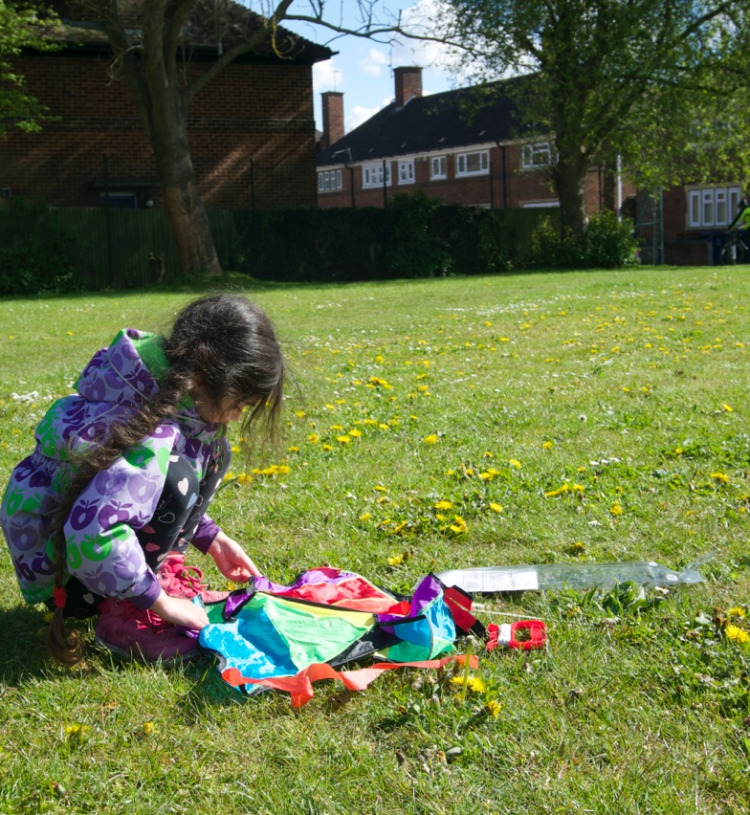
(a) Safety and community cohesion: Surveillance is a key issue for local parents. There are frequently far more children than adults on Bertie Park. It is often the first place that children in our area are allowed to go on their own.
| NPPF 96: “Planning policies and decisions should aim to achieve healthy, inclusive and safe places which: (a) promote social interaction, including opportunities for meetings between people who might not otherwise come into contact with each other. (b) are safe and accessible, so that crime and disorder, and the fear of crime, do not undermine the quality of life or community cohesion.” |
The 2023 planning statement says that “the proposed site layout has been designed to create a safe environment for new residents and the existing community. Throughout the design development of the masterplan, measures have been taken to design out the possibility of crime arising within the area” (PS 4.1.14 p14).
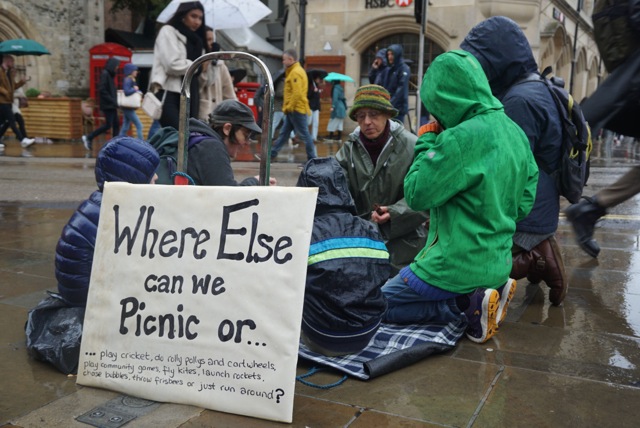
One of the design principles is “to provide a MUGA and play facilities that encourage community integration.” (PS 7.1.7). The client brief is “to effectively change the use classification of Bertie Place A for the provision of a close-knit proposed development that encourages community integration” (Design Access Statement 3.1 p8). Bertie Park currently provides ample opportunities for meetings between “people who might not otherwise come into contact with each other,” it caters for all ages with space for football, basketball, bike riding, swinging, spinning, climbing, picnics, cricket, dog walking, kite flying, running around etc. OCC want to split the park into two separate sites on either side of the Redbridge Stream, which are not mutually visible. Site B will only be accessible by a footbridge which TVP say is “very narrow and constrained, leaving users of this space at greatly increased risk of crime, with no option for escape should they be approached by a hostile actor.”
On-site surveillance for the 250m footpath that OCC propose for site B is so poor that it “is not for young children to run round. It would not be safe to leave a small child on site B; parents would need to go with them.” Conversation with Stuart Moran 2021. TVP said site B “significantly lacks surveillance” and “is highly likely to be a significant attractor for crime and antisocial behaviour.”
TVP also criticised the lay-out of site A, noting that “permeable cul-de-sacs” have 110% more crime than true cul-de-sacs.

(b) Noise: According to the Green Spaces Strategy 2013, play areas should have buffer zones (objective 15). OCC propose a seating area 5m away from flats. The current MUGA is 40m away from homes, the new one will be 11m away. OCC recommend solving potential problems (for residents) by restricting when the MUGA could be used and providing easy ways for residents to “report noise complaints, damage and/or misuse” (campaign objection 9(f) pages 31-36). TVP say this creates “a risk of noise having a negative impact on residents, neighbour disturbances and community tension.” We are worried that our young adults will become the problem.
(c) “The Park is going from a bed sheet to a pillow case” (Katy):
- Reduction in catchment area: In 2022, the project architect stated that he was not aware of any capacity calculations, but that the proposed play area was an LAP (Local Area for Play) which “caters for children up to the age of 6 (within) a 1 minutes’ walk.”
- Reduction in size of playground: We measured the surface area of the current playground as 570m2. According to Rob Jeffs (Community Engagement Manager, OX Place) this will be reduced to 535 m2 (Jeffs), but capacity is further decreased by sloped landscaping which is “designed to help reduce potential flooding of the rest of the site” ( materials for the 2022 consultation) and disabled access to the MUGA. There are also 5 street trees (layout of playground) which are included in the biodiversity calculations, and outdoor seating as the new facilities are obviously not just for us, but serve the needs of the residents of the new development. According to Jeffs, the area of the new safety surface is 172.7 m2 (Jeffs). This is a 78% reduction.
- Reduction in size of MUGA: The current MUGA is a basketball pitch and equates to a small 5-a-side football pitch. According to the equalities impact assessment (p.128), there will be a 25.5% reduction in area of the MUGA, but the dimensions also change so that it is shorter and wider.
- No space for free play: Roughly 80% of the park is currently available for free play. According to the equalities impact assessment (p128) the only space for free play will be new MUGA.
- Ecological buffer zone: The Environment Agency has imposed a planning condition that there should be a 10m buffer zone from the top of the bank of the Redbridge Stream. This in not shown in the available plans, but further constricts the area available for reprovision of the recreation ground. We think that this might explain why, in the 2045 local plan, the housing requirement drops to 25.